Hey community! In the third continuation of my CBO Interviews series, I sat down remotely with Sélim Benayat earlier this month, one the brilliant minds and the team lead behind Nothing’s AI products and initiatives.
Missed reading other CBO interviews? Check out my interview with Hollie Bishop, Global Growth Marketing Director and Heru Prasetyo, Original Content Lead.
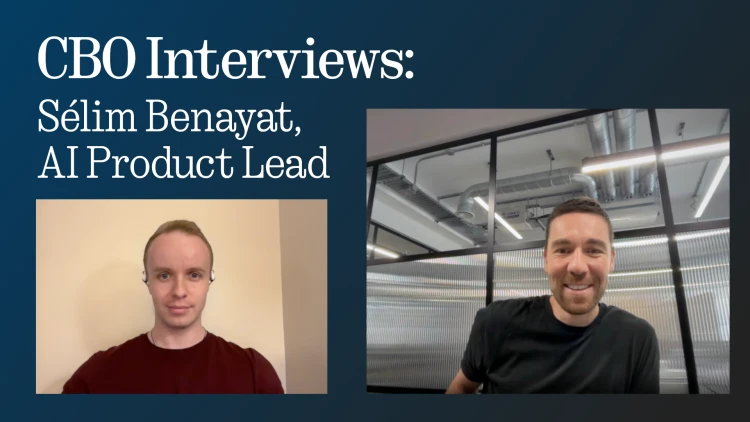
Adam Bowman (CBO): Thanks for taking the time to sit with me today, Sélim! You’re relatively new to Nothing - it’d be nice for the community to get to know you a little bit more. Could you tell us a bit about yourself?
Sélim Benayat: I’m Sélim Benayat. I studied biophysics and then robotics, which pulled me into vision systems and how machines perceive the world. I later founded Bento.me - a simple, elegant way for people to showcase their work and identity online - which was acquired by Linktree. At Linktree I led product across the main app, link placements, ads, and e-commerce. So my background is very much consumer, design-led, and fast iteration: ship, learn, refine.
Adam: Thanks for sharing, I’m sure many of us have heard of and used Linktree! How about your transition into Nothing, what enticed you to join, and what is your role today?
Sélim: I think the simplest answer is because Nothing builds cool s***, and I wanted to be part of that. A more nuanced answer would be that in the AI era, embodiment matters - intelligence gains real utility when it can sense, act, and respect context in the physical world. That’s what attracted me. Nothing has proven they can build physical objects, so I wanted to fill them with life. My role is to lead AI & Services, which means I listen to our users, set the overall product direction, translate it into roadmaps, and work across design, engineering, product, and marketing to ship experiences that, hopefully, feel inevitable once you use them. It’s basically about building a fully operational software company - focused on AI - inside of Nothing.
Adam: And what would you say you do on a day to day basis?
Sélim: Two different modes. One, I think a few years out about how AI changes consumer electronics and define the system - memory, models, devices, UI, etc. Two, I turn that into shippable increments with the team - priorities, prototypes, metrics, and delivery. It’s strategy level, to code and design review, to pushing out to the market, and then back to strategy.
Adam: AI is still relatively “new” in the world of tech - you started with robotics, how did you come to work in the AI space?
Sélim: Robotics and AR forced me to think about perception, intent, and action - AI by another name. I’ve always been curious about how technology reshapes behavior; call it an anthropological lens on adoption curves. At Linktree I leaned into ML for ranking and monetisation.
I’m just very curious about the future of technology and try to understand where society is moving. A couple of years ago, that naturally drifted towards AI. And now today, moving into hardware is the natural next step, because the closer intelligence sits to sensors and daily context, the more useful it becomes to us.
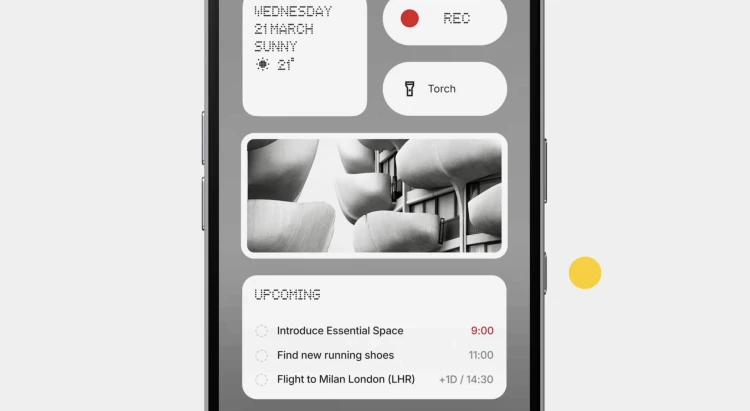
Adam: That’s cool! You mentioned obviously marrying software and hardware together. How do you approach it differently when a company, like Nothing, manufactures both the software and hardware themselves? I imagine that’s quite a unique position to be in.
Sélim: It lets us design the whole loop. Upstream, we co-plan with silicon partners so we know what the next NPUs and ISPs can do and shape features accordingly. Downstream, we exploit the sensor stack we already ship or will ship in new ways. Because device, OS, and services are under one roof, we can trade off latency vs. privacy vs. battery explicitly and build outcome-first flows instead of app-first silos.
Adam: What do you think about how the AI space has evolved over recent months?
Sélim: The centre of gravity is shifting from “bigger LLMs” to better systems. Pure next-token prediction is hitting practical ceilings - data quality, cost, and latency - so progress now comes from orchestration: tool-use, retrieval, longer-lived memory, and tighter loops between model, device, and cloud. Frontier models still improve, but differentiation is moving up the stack: product integration, privacy architecture, and real-world execution. That’s why the most interesting metric isn’t benchmarks; its completion rates - how often the system turns intent into outcomes with minimal friction.
Adam: Do you have any feelings on the complications or dangers of AI?
Sélim: Couple of thoughts. First, misaligned incentives. Optimise for engagement and you hijack attention; optimise for outcomes and you free it. Second, privacy and control. Without local memory and clear consent, personal AI collapses into surveillance. Third, brittle autonomy. Agents with tool access must be bounded, auditable, and interruptible; hallucinations and prompt injection are security issues, not “quirks”. Fourth, energy. As workloads scale, we need energy-aware systems: on-device when efficient, deferred/scheduled compute when possible, and hard budgets. The answer is architectural: privacy-by-design, reversible automation, human-in-the-loop for consequential actions, and evaluation on task completion - not clicks.
Adam: Do you think there’s a risk of “too much AI”, where humans become lazy and reliant on AI to do their daily tasks and thinking for them?
Sélim: That’s one that I’ve been thinking a lot about. I think one of the skills of a good product person, regardless of AI or not, is to be heavily grounded in the reality of human behaviour. The fundamental truth about the universe is that you want to reach an equilibrium state of energy - the lowest amount of energy spent and the highest return.
Humans naturally minimise effort. Technology reveals that; it doesn’t create it. Our job is to channel it: remove drudgery, not agency. Design for “fewer steps, but keep decisions alive” - the system handles orchestration, you keep goals, taste, and the final cut.
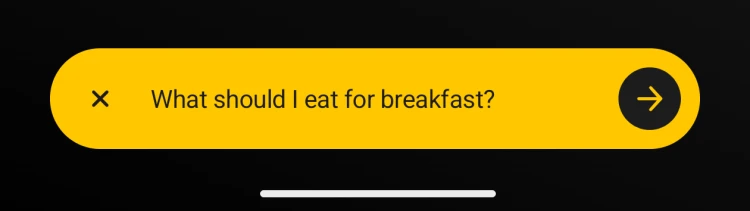
Adam: How do you foresee AI blending into our lives over the next few years?
Sélim: AI will recede into the interface and return agency to users. You’ll declare intent (actively or passively) - “move this meeting, send the notes, reorder the usual” - and the system will plan, act, and confirm, drawing on a personal memory you can inspect and control. The result is lower cognitive load: fewer steps, less context switching, and more time back. Augmentation over replacement
Adam: Sounds like things could get easier for end users. How do you think our interactions with phones may change in the future?
Sélim: The phone becomes a mediator. Instead of drilling through apps, you’ll use outcome-first surfaces that route tasks to the right tools. The device coordinates with nearby sensors found in earbuds, watch, glasses, and chooses the lightest-weight path: on-device when private and low-latency, hybrid when the task needs the additional compute. Success looks like fewer taps, shorter sessions, and a higher rate of completed tasks. We track that with a simple north star: how often the system turns your intent into action.
Adam: Do you feel that Nothing may branch out into different types of hardware in future?
Sélim: Yes. Phones won’t be the only entry point. There’s a class of purpose-built devices that capture, recall, and express in ways phones can’t - because the fusion of context (intelligence), form factor, and sensors changes what’s possible today.
Building AI hardware is something we think a lot about. It’s a class of products that we will be talking more about, early next year for sure.
Adam: We’ve seen some examples of AI-native devices on the market already that appear to have struggled to get off the ground. Lots of people, like me, still view their phone as the primary device to carry and interact with on a daily basis.
Sélim: We’re not looking to replace the phone right now. Phones are tremendously powerful at what they do. At the same time, it’s not going to be the only entry point because the phone is in your pocket most of the time.
There are two modes currently, and I believe only one of the modes is going to win in the market.
The winning approach is adjacent possible: ship the next step that earns daily default status, then compound. Big-bang bets for a hypothetical 10-year future tend to freeze you. It’s analysis paralysis. Thin slices that solve real jobs today create the runway for new form factors. You have to be in the market to learn.
One of the examples that I tend to think about is the build-out fibre. History rhymes. In the 90s we overbuilt fibre and data infrastructure; the dot-com bust followed. A decade later the true beneficiaries weren’t the network owners but the aggregation layer - search, social, streaming - soaking up surplus bandwidth and attention. No one laid fibre to enable infinite scroll.
The landscape of possibility for AI feels similar - just 10x that.
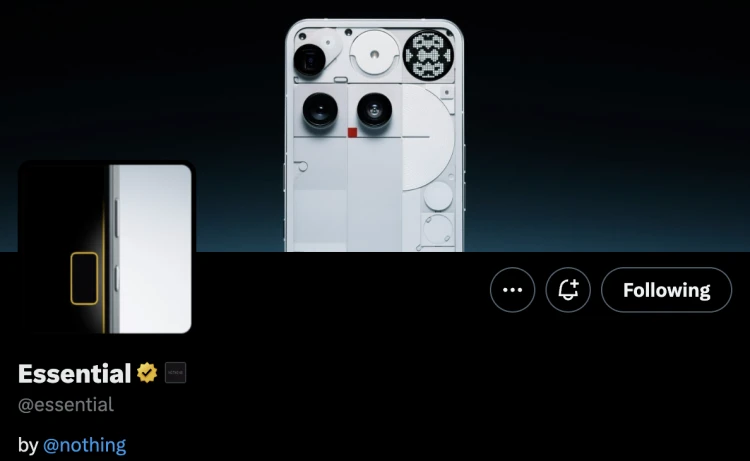
Adam: We recently saw the @Essential (X/Twitter) handle become active again - what are the plans for this, and why is it separate to the @Nothing handle?
Sélim: Currently that handle is led by the AI team, and the idea is to build even greater rapport with our community, because I truly believe in the creative power that our community holds. I want to keenly listen to community feedback. If we use the Nothing account, it comes with corporate language, a certain vibe and a set of expectations from the community. It becomes difficult to engage. With the Essential account, I can just jump into the replies and take notes - and believe me, I’m reading every single reply. In the future, it will keep on expanding. It’s the umbrella account for all of our Essential products, current and future.
Adam: Do you ever see Essential becoming its own LLM or Nothing working on their own AI?
Sélim: Never say never, but near term we focus on product, not frontier research. We’ll use the best models, on-device and cloud, often in a mixture-of-experts setup, and differentiate on integration, privacy architecture, evaluation, and experience quality. Users feel latency, reliability, and fit to task, and this is what Nothing is world-class at. Creating experiences that have an impact and that matter to real people in the real world. Not some benchmark.
Adam: Are there any AI features or solutions that you’ve dreamed of building into a consumer product or any AI products that you want to see released?
Sélim: Hundreds! I’m very excited about embodiment in AI - what types of products can we build that truly interact with the world around us? Or mixed reality devices that elegantly create an illusion for us to interact with - such products I’m very bullish about. But that’s just me. From a Nothing perspective, that translates to purpose-built devices that bridge digital and physical in clear, everyday jobs.
Adam: Looking forward to hearing more when the time comes! Are you using AI day to day internally in any of your processes?
Sélim: The way we use AI in the AI team has a lot to do with efficiency and augmentation. We use AI for idea visualisation, design iteration, and even more rapid prototyping. The goal is simple: AI should help every team member move more quickly, so cycles shift from “describe > build > test” to “try > refine > ship.”
Adam: Thanks once again, Sélim! It’s been super interesting hearing your journey into your role and how you and Nothing think about and implement AI into products and services.
—
I hope you found this interview as interesting as I did! Thanks to Sélim for taking the time to sit with me. I’m certainly intrigued as to how Nothing will venture into the AI-native hardware space in future.
What kind of products would you like to see from Nothing? Let us know below!
