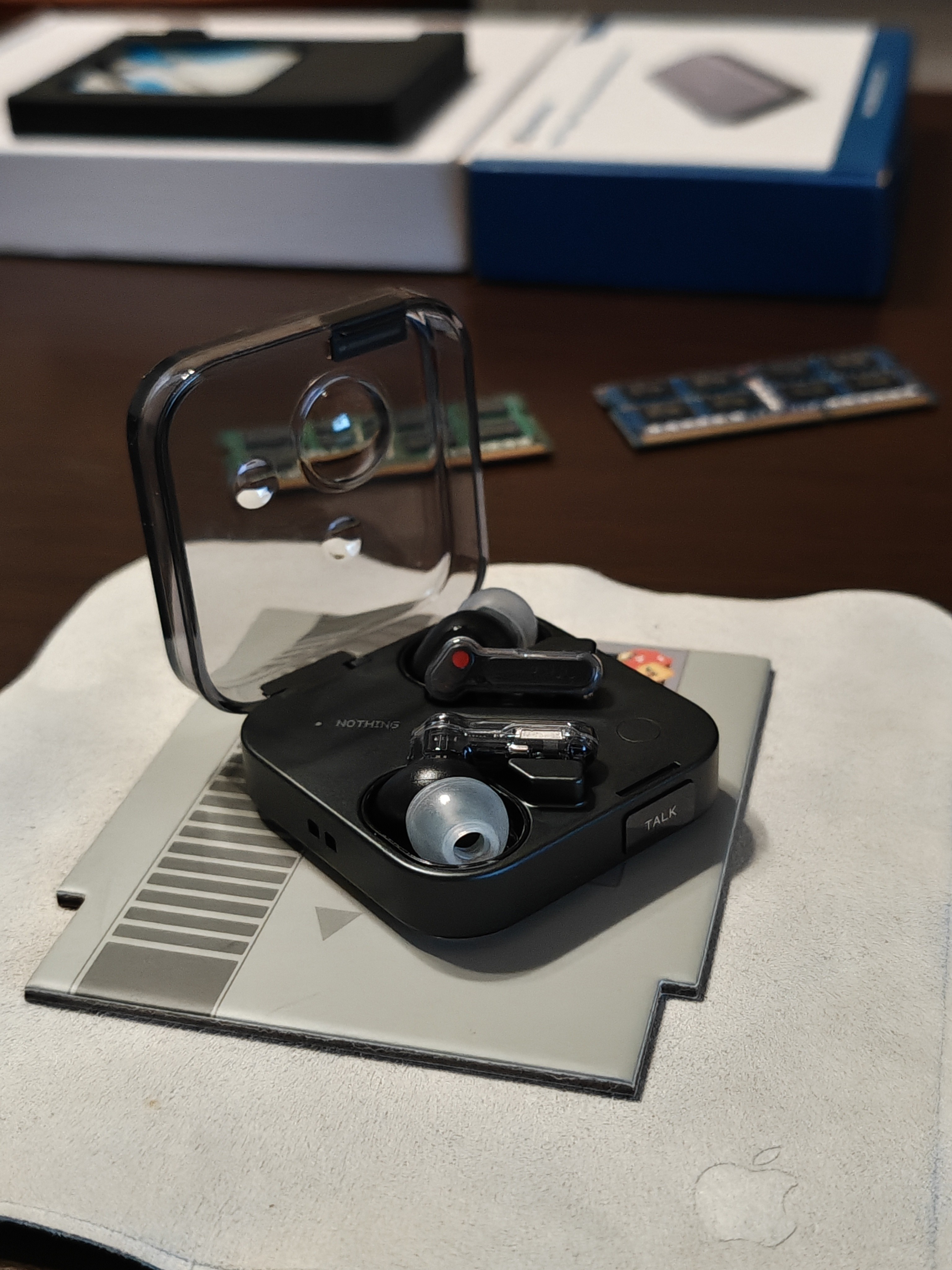
I have been deep in the Nothing ecosystem since early on. I’ve owned nearly every major release starting with the Ear (2). While I have used competing products from competitors like Sony, Samsung, and Google, I prefer Nothing for their unique design approach.
I’ve spent the last month testing the new Ear (3) against last year’s Ear (2024) and even my trusty Ear (open) buds, and honestly? This feels like the product I’ve been waiting for. Here is why I think this is the most refined set of in-ear buds they’ve ever made.
The Build: Premium Materials
The first thing you notice is the improvement in materials. Nothing has moved away from the all-plastic construction of the case used in previous generations, integrating aluminum accents and a metal bottom plate into the case. Instead of the usual plastic, you get a case made from 100% recycled aluminum that’s been refined through 27 separate precision processes to make it feel truly premium in your hand.
It’s not just for looks; the added density makes the case feel substantial and durable, removing the “hollow” feeling previous Ear models had. The stem of the buds feature custom Metal-Insulator-Metal (MIM) antennas engineered to just 0.35 mm thick. The hinge tolerances are tighter, and the whole package finally feels like premium hardware.
The Super Mic: Function Over Gimmick
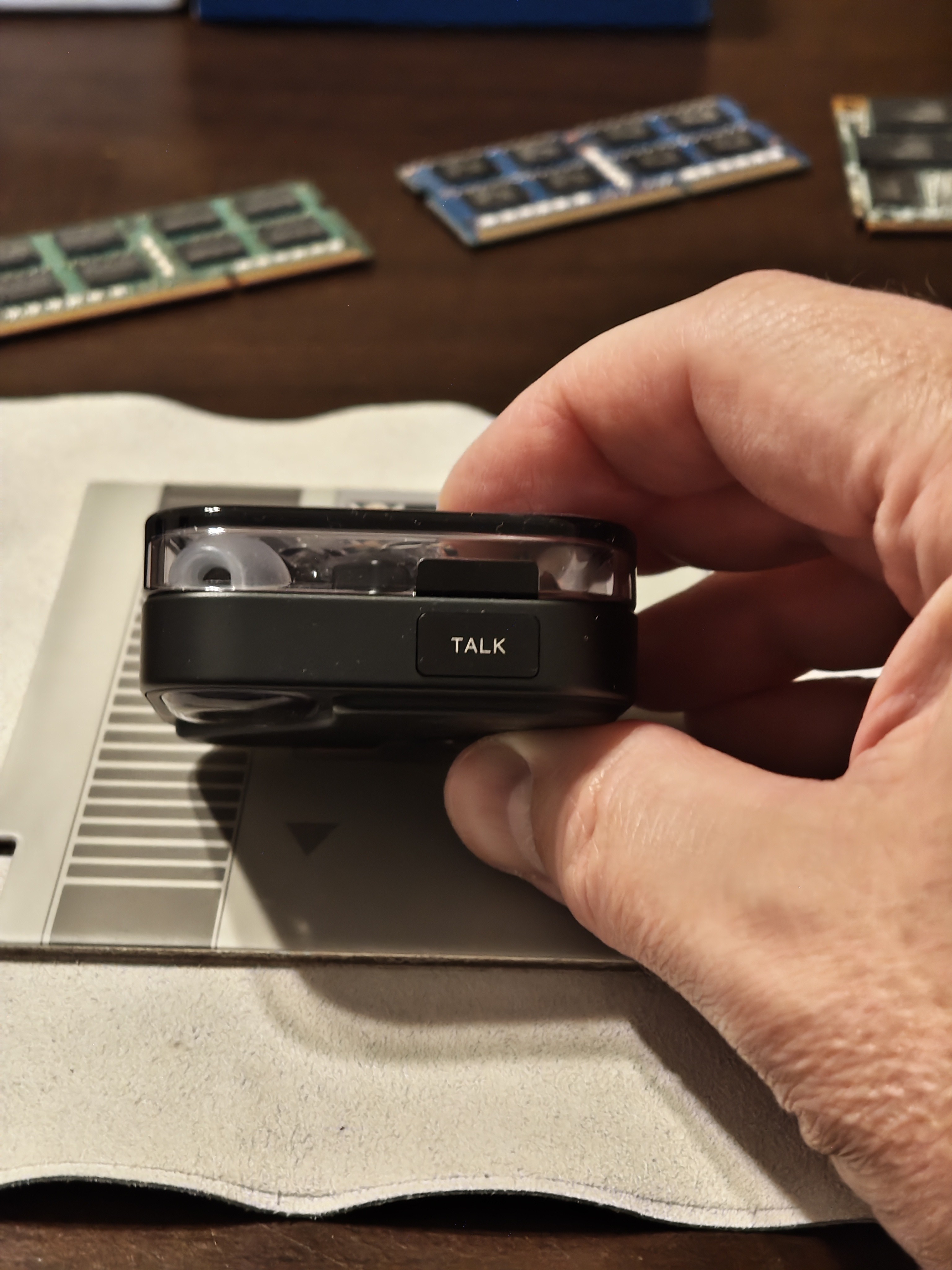
When I read about the new “Talk” button on the case, which turns it into a handheld microphone array, I was skeptical of the practicality. The engineering logic is that by moving the mics from your ear to your hand, you bypass the wind noise and processing struggles typical of standard beamforming.
I tested this for myself in the real world by calling my spouse from my busy office with some loud grunge rock playing in the background. While she could hear me pretty clearly in the “normal” configuration (just using the earbuds as we all typically do), using the Super Mic with the case held up like a traditional handheld mic she could hear me perfectly. The controls are surprisingly natural: you press and hold the Talk button for quick calls or voice notes, or double-press to lock the Super Mic on for those longer conversations. It cuts through up to 95 dB of ambient noise and made it a genuine problem-solver during the rush of holiday shopping.
The Sonic Evolution: 11mm Ceramic vs. 12mm PMI
When comparing the Ear (3) to last year’s Nothing Ear (2024), the most immediate difference isn’t just the case - it’s the punch. While the 2024 model’s 11mm ceramic driver was a massive leap for clarity, the new 12mm driver in the Ear (3) feels fuller. By moving to a PMI + TPU construction, Nothing has managed to significantly increase the bass response without muddying the mids. I did some research on PMI, an abbreviation for Polymethacrylimide. This is a material used in higher-end audio equipment due to an inherent property it possesses that dampens vibration quickly resulting is less echoing and crisper sound definition.
Last year’s model was great if you wanted every tiny detail perfectly in place, but the Ear (3) is really for those of us who just want to feel the music. Everything sounds more open now. It’s less like you’re listening to a studio file and more like you’re standing right at the front of a live show.
Purpose-Driven Design: The In-Ear vs. Open-Ear Tradeoff
Living with the Ear (open) for the last year changed how I view daily carry. For walks or office work where I need to stay present, the Ear (open) remains undefeated for comfort and availability. However, switching back to the Ear (3) for a focused listening session reminds me of what I’ve been missing: isolation. The Ear (3) features an upgraded Adaptive ANC that recalibrates every 600 milliseconds. Compared to the 2024 Ear, it’s significantly better at silencing the high frequency “hiss” of running air conditioners - living in Florida they are inescapable. While the Ear (open) is my choice for situational awareness, the Ear (3) is my go-to device for rest and relaxation. The seal is tight without feeling pressurized, an issue with the older Ear products that has finally been smoothed out.
Stability and Ecosystem: The Bluetooth 5.4 Edge
Using these alongside the Nothing Phone (3) highlights just how much work has gone into the software handshake. The jump to Bluetooth 5.4 and the inclusion of LDAC as the primary high-res codec (moving away from the more niche LHDC on the 2024 model) means a much more stable connection in high-traffic areas. I’ve noticed fewer “stutters” when walking through my office compared to my older buds. Plus, the integration with Nothing OS, specifically the automatic transcription of voice notes from the Super Mic into the Essential Space app, makes this feel like a cohesive tool rather than just a pair of headphones. I’ll really make use of this once the promised updates to Essential Space come to fruition.
Living with Two Phones (Multipoint & Compatibility)
My tech life is split. My personal daily driver is the Nothing Phone (3), but for work, I’m locked to an iPhone 17 Pro Max.
Fortunately, Nothing doesn’t gatekeep features. The Nothing X App gives you full access to EQ and controls on iOS just like it does on Android. The only features missing from Ear (3) on iOS are the Essential Space and ChatGPT integrations. I use Dual Connection to keep them paired to my Windows laptop and my phone simultaneously. The handoff is seamless, unlike with Apple AirPods, which punish you for leaving Apple’s walled garden - these are truly device-agnostic.
Sound Quality: Immersion & Tech
If you are deciding between these and the Ear (open), it comes down to the seal. The Ear (3) uses a silicone tip to create a pressure seal, which acts like a closed system. The result is that visceral, thump-in-your-head bass that open earbuds just can’t physically produce.
The Ear (3) also integrates Audiodo Personal Sound and a Real-Time Compensation algorithm. Think of it like “HDR” for your ears. It actively analyzes the music every millisecond; if the volume is low, it boosts detail so you don’t lose clarity. If it’s high, it compresses harsh frequencies to prevent fatigue. It ensures clarity without needing to crank the volume.
Specs: ANC and Battery
The Active Noise Cancellation (ANC) is finally competitive, offering a claimed 45dB reduction. In practice, it effectively erases low-frequency drones like fans or engines.
Battery life has also seen a necessary bump. I am consistently getting more than 5 hours of use with ANC on, which is a measurable improvement over the previous generations.
The Brains: Smarter Software
The hardware gets the headlines, but the software is what actually makes the Ear (3) feel like it was built specifically for your ears. While Nothing has had personalization features before, this year feels like they’ve finally matured into a cohesive ecosystem experience.
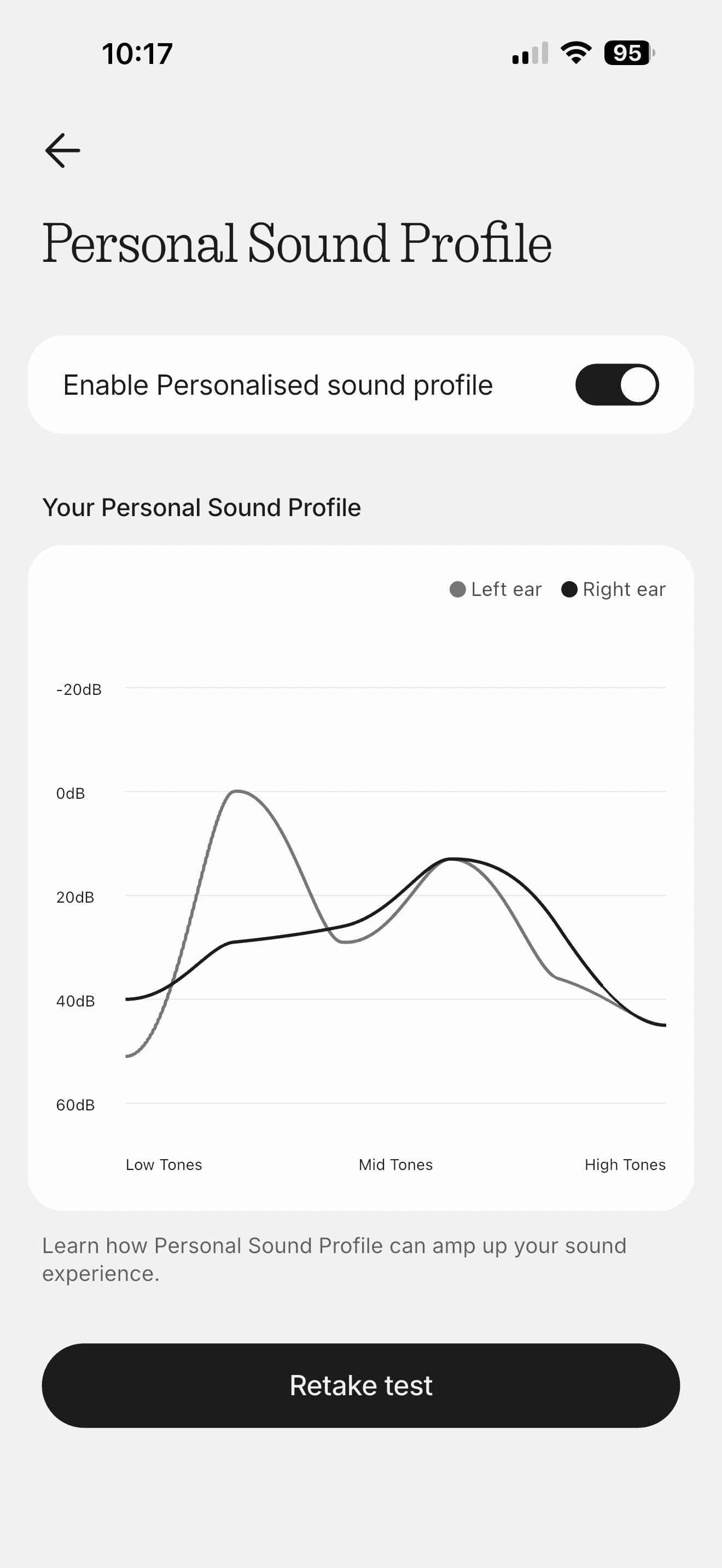
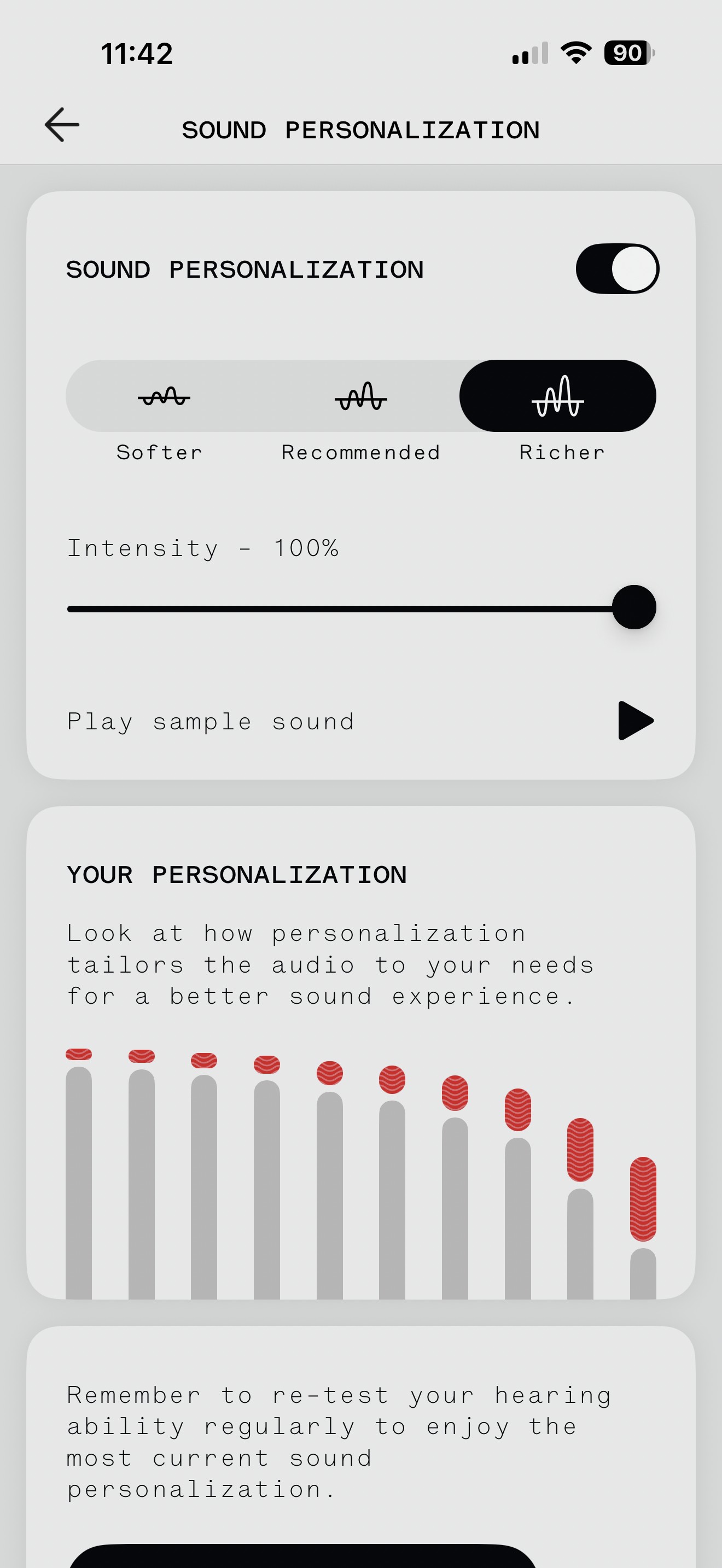
- Personal Sound Profile (Mimi vs. Audiodo): Last year’s Ear (2024) used Mimi Hearing Technologies to tailor sound, and while it was good, it could sometimes feel like a simple volume boost. The Ear (3) has switched to Audiodo, which uses a medical-grade hearing analysis in the Nothing X app to map your threshold sensitivity across the entire frequency range. Instead of just being “loud,” it compensates for the nuances of your specific hearing, essentially filling in the gaps, to make the music feel “beat-perfect”. Initially, I was surprised by how different the output graphs looked between my Ear 2024 and Ear (3) profiles, but the result of the new technology was true improvement. I happen to suffer from occupational hearing loss and tinnitus, so this one improvement is exceptionally meaningful to me. Here is a comparison between the profiles generated for me by Ear (3) and Ear (2024).
Advanced 8-Band EQ & Sharing: If you’re a power user, the 8-band equalizer is a massive leap over the simple presets found in older models. You can tweak the frequency and the “Q” (the width of the band) to pinpoint exactly how you want your audio to hit. A great new touch is the ability to share your custom EQ via QR code, so you can swap profiles with other Nothing fans.
Static Spatial Audio & Dynamic Bass: This generation introduces Static Spatial Audio, which creates a 3D soundscape for movies and music, putting you right in the center of the action. They’ve also added Dynamic Bass Enhancement, which intelligently boosts low frequencies in real-time without muddying the rest of the track.
Essential Space & ChatGPT: The integration with your Nothing Phone (3) is deeper than ever. You can now use the Super Mic on the case to record quick thoughts that automatically sync and transcribe in Essential Space. Plus, a double-pinch on the buds launches ChatGPT directly, allowing you to prompt the AI without even taking your phone out of your pocket.
Intelligent Noise Control: The ANC is now fully adaptive, checking your environment every 600 milliseconds. It even runs a “fit-test” every 1,875 milliseconds to detect any sound leakage if the buds shift while you’re moving, ensuring the isolation stays rock-solid.
The Verdict: Choose Your Champion
After living with the whole lineup alongside my Nothing Phone (3) and my iPhone 17 Pro Max, it’s clear that Nothing isn’t just making gadgets anymore, they’re building a toolkit. Deciding which one to grab depends entirely on what your day looks like.
For the Workday: Ear (open)
If your day is a marathon of phone calls and Teams meetings and needing to hear when the delivery driver knocks or when a colleague is speaking to you, the Ear (open) is the clear winner. They are the most comfortable buds I’ve ever used for long stretches because they don’t plug your ears allowing you to stay aware of your environment without sacrificing audio quality.
For Entertainment: Ear (3)
When it’s time to clock out, the Ear (3) is the one you want. The redesigned 12mm dynamic driver provides a wider soundstage and deeper bass than the previous generation. Between the Static Spatial Audio for movies and the Dynamic Bass Enhancement, the experience is far more immersive and “live” than anything they’ve released before.
For the “Power User”: Smarter Software
The software is where the Ear (3) really pulls ahead.
Tuned to You: The Personal Sound Profile uses a hearing analysis to compensate for your specific frequency sensitivities, making the audio “beat-perfect” for your ears.
Ultimate Control: The 8-band equalizer lets you pinpoint exactly how you want your music to hit, and you can even share your custom profiles via QR codes.
AI Integration: You can launch ChatGPT with a double-pinch or use the Talk button to record notes that automatically sync and transcribe in Essential Space.
The Differentiator: The Super Mic
If you take calls in the real world—windy streets, loud offices, or machine shops—the Super Mic is the reason to upgrade. By pressing the Talk button and holding the case like a traditional microphone, you use a dedicated dual-mic system that cuts through din of the world around you. It’s a game-changer for call clarity that standard earbuds simply can’t match.
To Upgrade or Stay Put?
Stick with the Ear (2024) if: You already own them and mostly use them in quiet environments. They are excellent earbuds, and if you don’t find yourself struggling to be heard on calls or needing “pro-level” EQ, you’ve still got a great product.
Upgrade to the Ear (3) if: You want the best Nothing has to offer. The jump to aluminum and metal construction makes the hardware feel premium and durable. But the real reason is the “Super Mic” and the Audiodo-powered sound personalization - it’s a more refined, professional experience in every way.
