I recently reflected on my blog about what is happening with the Nothing Phone (3). Here it is:
The Nothing Phone (3) one year later: Does Nothing treat its flagship as it deserves?
It has been a year since the Nothing Phone (3) hit the market as the brand’s big promise, the device meant to prove that Nothing could compete head-to-head in the high-end flagship league. After twelve months of daily use, no one can deny that it is the most powerful and complete smartphone they have built to date.
However, in today’s technological world, excellent hardware is nothing without equally strong software support. And it is precisely here that a reasonable question arises, one that has been brewing in my mind for the past few months: Are we really looking at a flagship device?
For me, being a brand’s flagship isn’t just a label that justifies a higher price tag. It’s a commitment to care and absolute priority toward the user. Unfortunately, recent reality is showing us a rather frustrating trend.
The unfair comparison with the mid-range
What hurts me most as a Phone (3) user is seeing how the smaller siblings in the family, mid-range or low-end devices that cost up to 300 euros less, enjoy new software features much sooner than the flagship device. This is the case with the AI-powered erasing functions in the Gallery or the advanced image editing tools in the camera, present on the Phone (4a), Phone (4a) Pro and Phone (4b) models, but completely absent on the flagship. Nor have the new (4a) series camera widgets arrived, nor the video presets, nor the dual-camera feature that the Phone (4b) just debuted.
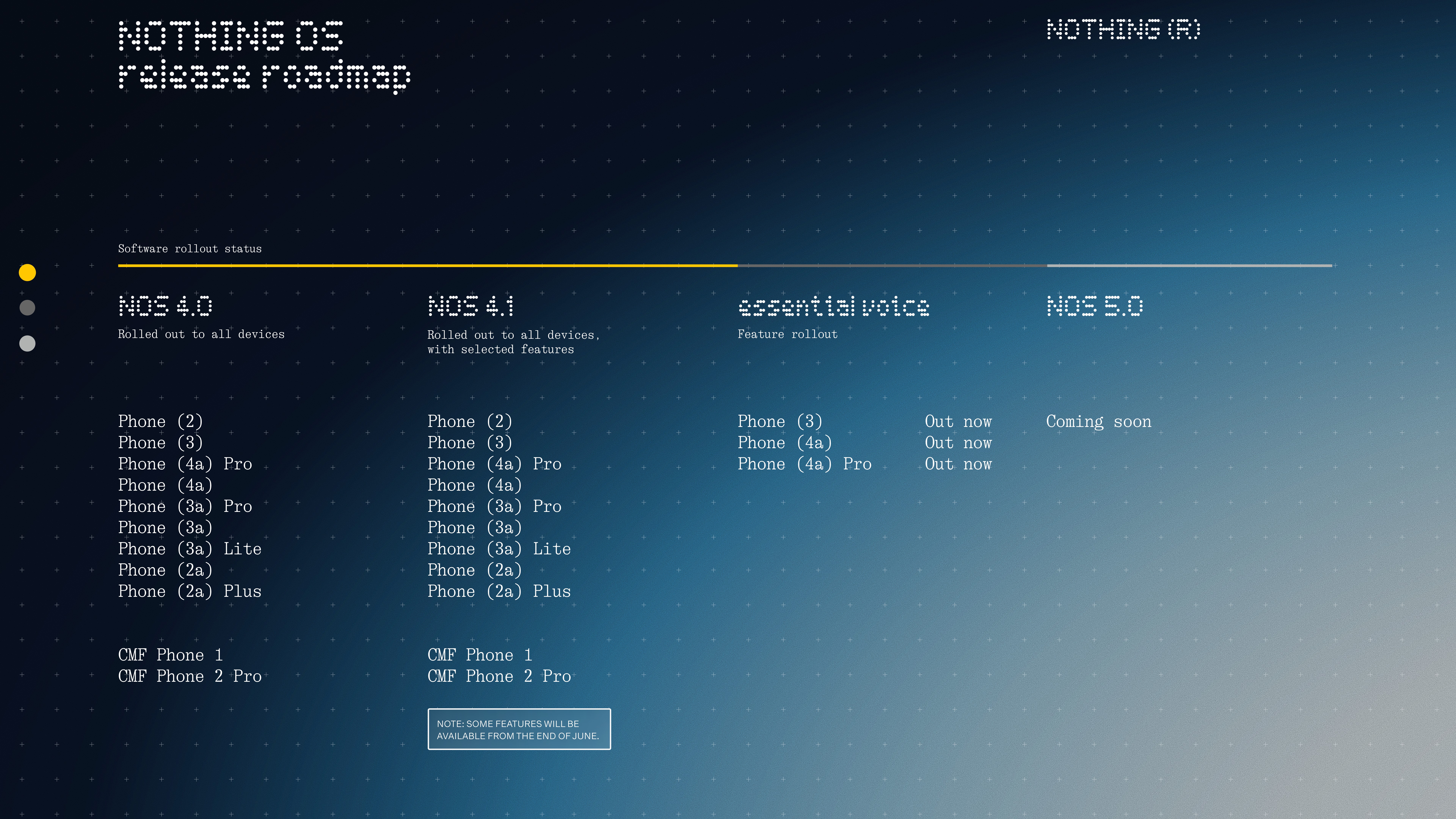
To make matters worse, cross-cutting new features like Essential Voice improvements will reach the Phone (3) in August, representing a delay of at least two months compared to more affordable handsets. I am genuinely glad that users on tighter budgets get to enjoy these options, but I believe the brand’s most expensive device should, at the very least, keep pace in development timelines rather than lagging behind.
When your younger brother surpasses you…
Frustration increases when we analyze pure day-to-day performance. Currently, the main sensor of the Phone (3) processes some photos worse than the Phone (4a) Pro. I’ve noticed that the dynamic range and HDR performance in backlit situations are significantly worse on the flagship model than on the mid-range model. It’s been far too long since we’ve received a substantial update aimed at improving photo post-processing. While I want to believe that the development team is saving all the heavy artillery for the rollout of Nothing OS 5.0, the wait is becoming far too long and annoying.
To this I must add other details that tarnish the premium experience. The battery life falls well short of what the Phone (4b) offers, and certain annoying bugs still persist in the Glyph Matrix that are not experienced on the Glyph Bar of the newer models. Furthermore, seeing that with current deals the Phone (3) can be found at almost the same price as the Phone (4a) Pro makes me seriously question its actual status. A flagship should be superior in virtually every section, or at least not be so clearly outmatched by lower-tier models.
Is it really a flagship device?
This is where we get to the real heart of the matter and where I need to be more critical. It’s one thing to launch the most powerful phone in your catalog, and quite another to build a true flagship. The Phone (3) has the raw power, the latest generation processor, and the exclusive design—there is no doubt about that. But to me, a flagship is a status. It is the device that should lead the brand’s path, the one that should receive experiments and new features before anyone else, and the one that under no circumstances should be put to shame by cheaper models from its own lineup.
Seeing how mid-range phones are surpassing it in photo optimization, AI features, and the speed of updates leaves me with a bittersweet feeling. It gives the impression that Nothing designed its most complete phone yet, but without granting it the status or preferential treatment that a true flagship earns in today’s market. If it only stands out for having more raw power in benchmarks and its unique design, it falls halfway short of what we were promised.
A matter of priorities and affection
I know I might seem too demanding. To be fair, Nothing keeps to its schedule and delivers updates punctually every two months. In fact, if I compare it to phones from other companies, like Xiaomi, we are more than well taken care of with Nothing. But I would be lying if I didn’t admit that, over this past half year, real improvements for the Phone (3) have been diminishing in favor of new releases. I know Nothing can do better—they have proven it to me on countless occasions—and perhaps that is precisely where my disappointment comes from.
I completely understand the company’s business strategy. New products need attention to sell well. But Nothing urgently needs to find a balance if it doesn’t want to discourage or anger its most loyal customers. If users who have invested the most money in the brand feel that their device is not the one that receives the most care, trust is broken.
The Phone (3) was a major game-changer, but it needs the timely and preferential support that any self-respecting flagship should receive. I know Nothing will eventually update its flagship, and I hope they prove me wrong soon with a major update.
Link: NothingTec