Hello Community,
It’s a huge topic how to calculate your carbon footprint taking into account all the things we use every day.
So I translated this interesting article from a French website ‘Les Numériques’.
Fairphone tries (really) to calculate the carbon footprint of a smartphone.
A complex calculation for an urgent reality.
What is the carbon footprint of my smartphone on the environment? Behind this simple question lies an ultra-complex calculation that Fairphone is trying to popularise, using its own phone as an example.
Fairphone is playing it safe. The Dutch company, which has made a speciality of selling repairable and ecologically responsible phones, has just published the life cycle assessment (LCA) of its latest phone, the Fairphone 4. The report’s conclusions are obvious, but worth repeating: the best way to reduce the carbon footprint of your phone is to keep it as long as possible.
In the case of the Fairphone 4, using the phone for five years “could reduce the phone’s annual carbon footprint by 31%”. By using it for seven years, “emissions drop by 44%”, according to the company. To put it more simply, the emissions emitted during the production of the phone are more environmentally “profitable” if you keep your phone for a long time. The total carbon footprint is gradually “diluted” by what the earth is able to absorb in CO2 every year.
What is Life Cycle Assessment (LCA)?
To assess the carbon footprint of its phone, Fairphone used a standardised calculation method called life cycle assessment. According to Ademe (the French Agency for Ecological Transition), a life cycle assessment (LCA) takes into account “the inventory of flows, from cradle to grave: extraction of energy and non-energy raw materials necessary for the manufacture of the product, distribution, use, collection and elimination towards the end-of-life channels, as well as all the transport phases”. Rather than simply quantifying the CO2 emitted during the construction of the smartphone, the LCA will take into account the energy expended during the charging and disposal of the phone. This method has the advantage of being much more exhaustive than the simple calculation at the time of manufacture.
“The term ‘flows’ refers to everything that goes into the manufacture of the product and everything that goes out in terms of pollution. Among the incoming flows, we find, for example, those of materials and energy: iron resources, water, oil, gas. As for the outflows, they can correspond to waste, gaseous emissions, rejected liquids, etc.”, states Ademe on its website (French Agency for the Environment and Energy Management).
How does the Fairphone 4’s carbon footprint break down?
Fairphone’s massive 215-page study assesses the role of each component in the phone’s total carbon footprint. In terms of construction alone, the motherboard is unsurprisingly the most CO2 intensive, accounting for 71% of the emissions alone.
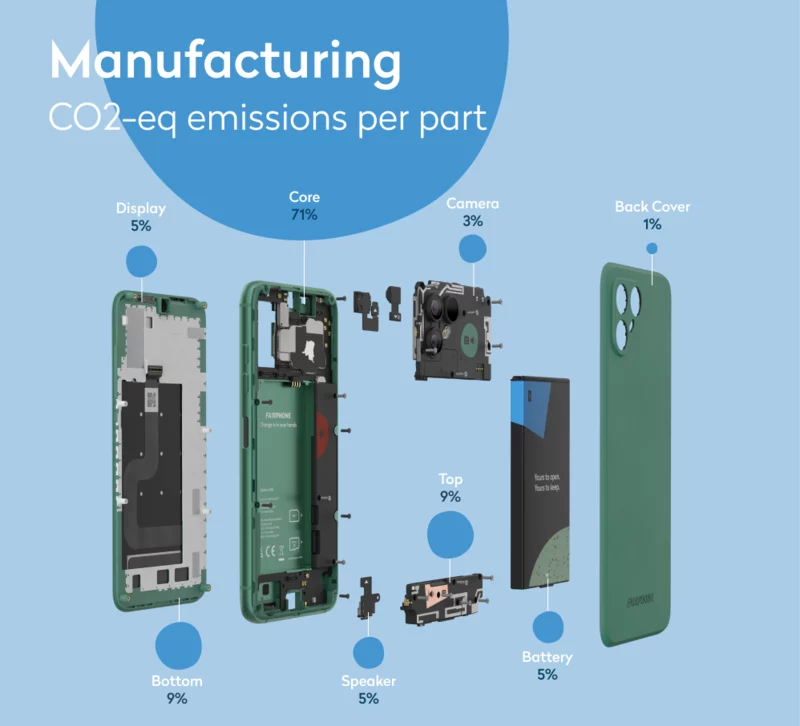 Exploded view of the Fairphone with the ecological impact of each component - © Fairphone
According to the study, the Fairphone 4 emits 43 kilograms of CO2 equivalent, a figure that is slightly up on the Fairphone 3 due to new features and components on board and “a higher proportion of air shipments during the Covid-19 period and the chip crisis”. Unsurprisingly, “most of the emissions and consumption of finite resources taking place during the production of the device”, Fairphone admits.
From the consumer’s point of view, the best way to reduce its impact (besides keeping the phone for a long time) is to repair it as much as possible. “The emissions created by the production of these spare parts, their packaging and shipment to the user, or the sending of the device to a repair centre, are thus theoretically offset after only a few weeks of additional use of the repaired device,” the company details.
Software liability
Finally, one of the last important building blocks for reducing the carbon footprint of smartphones is of course software monitoring. The longer a phone receives security updates, the less essential it is to replace it. From this point of view, few players in the Android world are beyond reproach. Samsung and Google offer between four and five years of monitoring and even Fairphone is not currently committed beyond 2025.
As you can see, it takes a lot of work to put a precise figure on the carbon footprint of a smartphone. But what the example of Fairphone clearly shows is that even if we are very careful about what we buy and how we treat our smartphone, there is still a lot of work to be done before we reach “sustainable” consumption. It should be remembered that in France, according to Arcep, “the individual duration of use of smartphones is estimated at between 23 months and 37”. This is far from the seven years proposed by Fairphone, or the 10 years proposed by other industry players. So it’s worth repeating: the greenest smartphone is the one you already have on you.
This article was written by Corentin Bechade
