Hi,
With next-gen flagships pushing well past €1,300, smartphone pricing is getting out of hand. This Nothing Phone (5) concept holds the line at €899 (matching the Phone 3 price bracket) by trading spec-sheet vanity for real-world impact. Instead of overpaying for 2nm silicon, LTPO backplanes, or ultrasonic scanners, every saved euro is reinvested where it counts: better cameras with Unified Color Science (3x SAMSUNG ISOCELL JNP 50 MP Secondary Sensors) with less motion blur and less shutter lag or less HDR ghosting, Super Dynamic Macro Engine (24-180 mm), bigger battery, USB-C 3.2 with DisplayPort 1.4 for future desktop mode. New technologies used like MPMA (Nanoprism / Metaphotonics Microlens Array) could be the competitive advantage, offering huge sensitivity boost and rapid focus tracking.
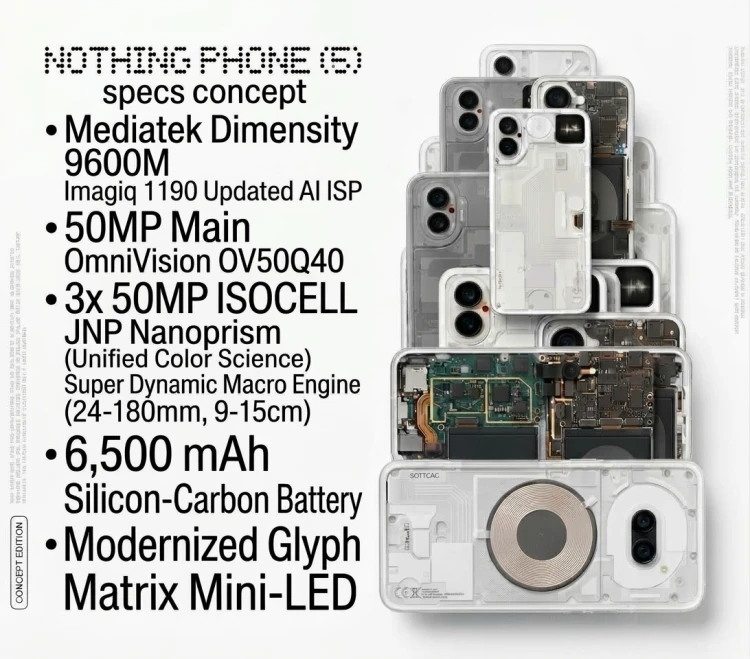
*DISCLAIMER: Above image is just for fun
📅 Expected Premiere Date and Price
- Launch Window: Mid-to-late 2027.
- MSRP Target: €799 (12 GB + 256 GB) and €899 (16 GB + 512 GB) — maintaining the launch price bracket of Phone (3).
- Strategic Timing: Releasing in 2027 following the mid-range series aligns the entire portfolio under the 5-series generation while bypassing the number 4. It positions Nothing to utilize mature, yield-efficient 3nm silicon right as unbinned 2nm flagships push competitor prices above €1,300.
⚙ Specifications Summary
- Display Geometry: 6.7-inch Flexible Modern Advanced LTPS AMOLED.
- Display Visuals: 1.5K+ (2800 × 1260, ~460 ppi), 30 Hz–120 Hz stepped adaptive refresh, 2000 nits HBM / 4,000 nits peak HDR, 2,160 Hz high-frequency PWM dimming.
- Processor: 3nm MediaTek Dimensity 9600M (Octa-Core All-Big-Core architecture, Arm Mali-G1 Ultra GPU, NPU 990).
- Memory & Storage: 12 GB / 16 GB LPDDR5X (8,533 Mbps) and 256 GB / 512 GB UFS 4.0 dual-channel TLC flash storage.
- Main Camera (24 mm): 50 MP OmniVision OV50Q40 (1/1.3″, 1.2 µm, PureCel®Plus-S, QPD 100% Direct Phase-Detection AF, f/1.68, OIS, 9 cm close-up).
- Periscope Telephoto (85 mm / ~3.5x): 50 MP Samsung ISOCELL JNP (½.74″, Nanoprism optics, f/2.6, Prism OIS, 15 cm Tele-Macro, ~180 mm lossless crop).
- Ultra-Wide Lens (14 mm / 119°): 50 MP Samsung ISOCELL JNP (½.76″, f/2.4, Fixed-Focus calibrated from ~40 cm).
- Front Camera (22 mm): 50 MP Samsung ISOCELL JNP (22 mm, f/2.2, Fixed-Focus calibrated at 50 cm arm’s length).
- Battery & Power: up to 6,500 mAh Silicon-Carbon cell, 65W USB-PD 3.0 / PPS wired, 15W Qi standard wireless, 5W reverse wireless power.
- Build & I/O: recycled aluminum midframe, Corning Gorilla Glass 7i (front and back), IP68 water/dust resistance, USB-C 3.2 Gen 2 (10 Gbps) with DisplayPort 1.4 Alt Mode and Desktop Mode, The Glyph Matrix mini-LED dot display.
✂ Summary of Price Cut-Downs
- MediaTek Dimensity 9600M (MT6994): Bypasses the 2nm wafer cost spike by adopting high-yield TSMC 3nm silicon while delivering top-tier CPU and NPU throughput at lower silicon unit costs.
- Flexible LTPS Display: Omits costly 1 Hz LTPO IGZO oxide layers, stepping refresh rates between discrete intervals (30/60/90/120 Hz).
- Gorilla Glass 7i Panels: on both front and transparent rear plates instead of expensive Victus 2 or Armor glass-ceramics.
- Standard 15W Qi Wireless: Eliminates heavy neodymium magnetic alignment rings and Qi2 controller hardware to reduce chassis thickness and cost.
- Ultra-Thin Optical Biometrics: Eliminates expensive 3D ultrasonic acoustic hardware with a wafer-level optical sensor, avoiding ultrasonic display bonding scrap.
- Fixed-Focus Secondary Optics: Removes Voice Coil Motor (VCM) autofocus actuators from the ultra-wide and selfie lenses, relying on hyperfocal geometry and the periscope for macro work.
- BOM Cost Consolidation: Sourcing the secondary optical stack (telephoto, ultra-wide, selfie) from a single vendor (Samsung Semiconductor) maximizes component purchasing discounts.
- Reduced f/2.4 Aperture on Ultra-Wide Lens: makes lens smaller to fit and cheaper.
- Mature UFS 4.0 Storage: Uses commoditized UFS 4.0 instead of UFS 4.1, avoiding early-adopter supplier premiums for automotive-oriented RPMB descriptors and QLC defrag tools while matching identical 4.2 GB/s bandwidth.
- Optional USB cut-down: USB-C 3.2 can be cut-down to USB 2.0 if Nothing doesn’t want introduce Desktop Mode.
📍 Strongest Points of the Cut-Down Decisions
- MediaTek Dimensity 9600M (MT6994): Probably the cheapest and most powerful 3 nm chip.
- Solid-State Mechanical Durability: Eliminating mechanical VCM motors on secondary cameras prevents internal suspension spring fatigue.
- Mature LTPS Display Technology: Premium LTPS screen can be cheaper and better looking in therms of color and brightness than a mediocre LTPO screen.
- Unified Color Science (Unified ISOCELL JNP Color Consistency): Using matched Samsung 0.64 µm JN-type sensors across telephoto, ultra-wide, and selfie eliminates white-balance drift across focal lengths and removes the need for an external color temperature sensor.
- The f/2.4 Aperture on Ultra-Wide Lens: Provides superior corner-to-corner sharpness (less distortion). Because the JNP sensor is highly light-sensitive, it survives the darker f/2.4 aperture without suffering from muddy noise reduction.
- Universal Glass Screen Protector Compatibility: The wafer-level optical fingerprint scanner reads reliably through standard, affordable 9H tempered glass without requiring specialized UV liquid adhesives or glass cutouts.
- Display & Battery Longevity: LTPS avoids the low-frequency gamma flicker and tint shifting of mid-tier oxide panels, while 65W universal USB-PD charging prevents heat stress on the 6,500 mAh Silicon-Carbon anode.
✅ Summary of Upgrades vs. Nothing Phone (3)
- MediaTek Dimensity 9600M (MT6994): Jumps from mid-tier 4nm silicon to all-big-core 3nm CPU architecture with massive NPU compute and sustained gaming thermals.
- OmniVision OV50Q40 instead of LOFIC: It is cheaper than OmniVision OV50K40 LOFIC Sensor and more power efficient than OmniVision OV50H40.
- True 85 mm Periscope with f/2.6 Aperture: Replaces basic 70 mm with a dedicated 85 mm (~3.5x) periscope featuring a floating tele-macro group (15 cm focus distance, +30% higher magnification) and lossless 180 mm zoom reach.
- Super Dynamic Macro Engine from 24 mm up to 180 mm: Instead of forcing the user into a single, dedicated macro lens, this setup provides a fluid, high-resolution close-up experience that changes its optical characteristics as you zoom. The 50 MP can zoom up to 2x-3x (50-70 mm) and can focus as close as 9 cm. The 50 MP telephoto can zoom loseless up to 7x (180 mm) and can focus as close as 15 cm. It turns macro photography from a single fixed mode into a flexible tool, giving you flawless close-ups across the entire zoom range (2x, 3x, 3,5x, 7x).
- Samsung ISOCELL JNP Superiority Over Standard Samsung ISOCELL JN5 in Periscopes: The Samsung ISOCELL JNP incorporates an on-pixel Nanoprism metasurface layer MPMA boosting light efficiency by +25%.
- Modernized Samsung ISOCELL JNP Ultra-Wide (f/2.4) and Selfie (f/2.2): Upgrades to Dual-VTG (+60% full-well capacity), on-chip hardware remosaic engines, and Dual Slope Gain HDR to eliminate low-light grain and shutter delay plus Nanoprism +25% light intake.
- Up to 6,500 mAh Battery: Jumps to high-density Silicon-Carbon (~830 Wh/L), providing +26% (+1,350 mAh) more capacity than Phone (3). Indian version had 5500 mAh battery.
- USB 3.2 + DisplayPort 1.4: Replaces the legacy 480 Mbps USB 2.0 port with a high-speed video interface driving native 4K @ 120 Hz monitor output and providing future Desktop Mode.
- The Glyph Martix: Upgraded, bigger and brighter mini-LED dot display, that can be used as macro fill-in light.
** EDITED 05.10.2026: Cut down from Snapdragon 8 gen 5 to Dimensity 9600M, and from Samsung Isocell 200 MP HPC to OmniVision OV50Q40 for better pricing.


